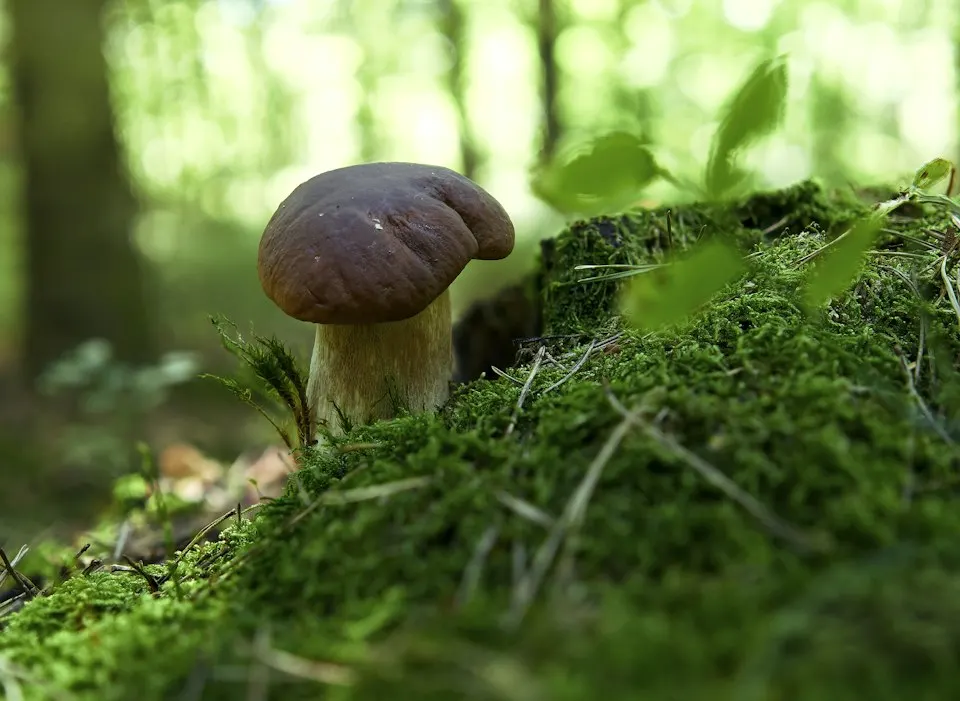
Mushrooms grow across the country, but not in equal numbers everywhere. The largest continuous forests, on sand and in the mountains, have drawn pickers for years. Below is an overview of seventeen regions, with a link to the forecast for each.
How to choose a region
- Start with a forest you can reach in an hour or two. A short drive leaves more time for the picking itself.
- Check the mushroom forecast to see where it rained recently. Mushrooms appear 4 to 10 days after rain, so do not pick a forest that stayed dry.
- Match the forest to the species. Slippery jacks and saffron milk caps grow in young pine forest, chanterelles in bright woods, and cep and bay boletes in mixed woods and older pine forest.
- Read the bans for the region. Many of these forests border a national park, where you cannot pick.
Pine forests in the north and west
- Bory Tucholskie: extensive pine forest on sand, slippery jacks, bay boletes and cep. The national park is closed to picking.
- Puszcza Notecka: pine on very permeable sand, slippery jacks and saffron milk caps, risk of closure in drought.
- Puszcza Drawska: pine forest with some beech, visited less, a military training area in the north.
- Kaszuby: hilly lake country, pine and beech forest, many reserves.
- Bory Dolnośląskie: one of the largest forest complexes in the country, military areas in the west.
- Lasy Stobrawskie: pine forest in the Opole region, close to Upper Silesia and Wrocław.
The north-east
- Puszcza Piska: the largest forest complex in Masuria, cep, bay boletes and chanterelles.
- Puszcza Augustowska: pine and spruce forest among lakes, with Wigry National Park inside.
- Puszcza Knyszyńska: a complex next to Białystok, crowded at weekends.
- Puszcza Białowieska: old forest, open to pickers outside the park, restrictions near the Belarusian border.
The centre and the east
- Puszcza Kozienicka: the largest continuous forest in Masovia, close to Warsaw.
- Lasy Janowskie: pine and mixed forest on the sands of the Lublin region, a landscape park.
- Puszcza Solska: the area around Biłgoraj, next to Roztocze National Park.
- Góry Świętokrzyskie: fir and beech forest, Świętokrzyski National Park closed to picking.
The mountains in the south
- Sudety (Góry Sowie): spruce and beech forest, with Karkonosze National Park and Table Mountains National Park nearby.
- Beskid Niski: gentle ridges with beech woodland, Magura National Park.
- Bieszczady: big forests, brown bears, Bieszczady National Park and a border zone.
What to expect in each type of forest
- Pine forest on sand (Tuchola, Noteć, Lower Silesia): mushrooms come up fast after rain, but disappear just as fast. They start with slippery jacks and chanterelles.
- Mixed forest and the big primeval-style forests (Pisz, Augustów, Białowieża, Knyszyn): the flush starts later but lasts longer, because the litter holds water.
- Mountains (Bieszczady, Beskid Niski, Sudetes, Świętokrzyskie): the season starts in the valleys and then moves higher. Take a map and check the weather forecast for the higher ground.
When the forest is crowded
Most pickers enter the forest on Saturday and Sunday, especially in forests close to big cities, such as Kozienice or Knyszyn. If you can, go on a Tuesday or Wednesday morning. Get a few kilometres away from the car park, because the forest around it is usually picked clean.
Before you enter the forest
Check that the forest is not closed because of fire risk, and that you are not walking into a national park or a reserve. The details are in where you can pick mushrooms in Poland. In the mountains and in the large forests, carry an offline map, because phone signal can be weak.
Pick only what you know for certain. The safety rules are in how to avoid mushroom poisoning.
Do not miss the next window
The best windows last a few hours: after a storm, after rain, on a clear night with an active Sun. Sign up and we will email you when the index at your spots goes above 60.