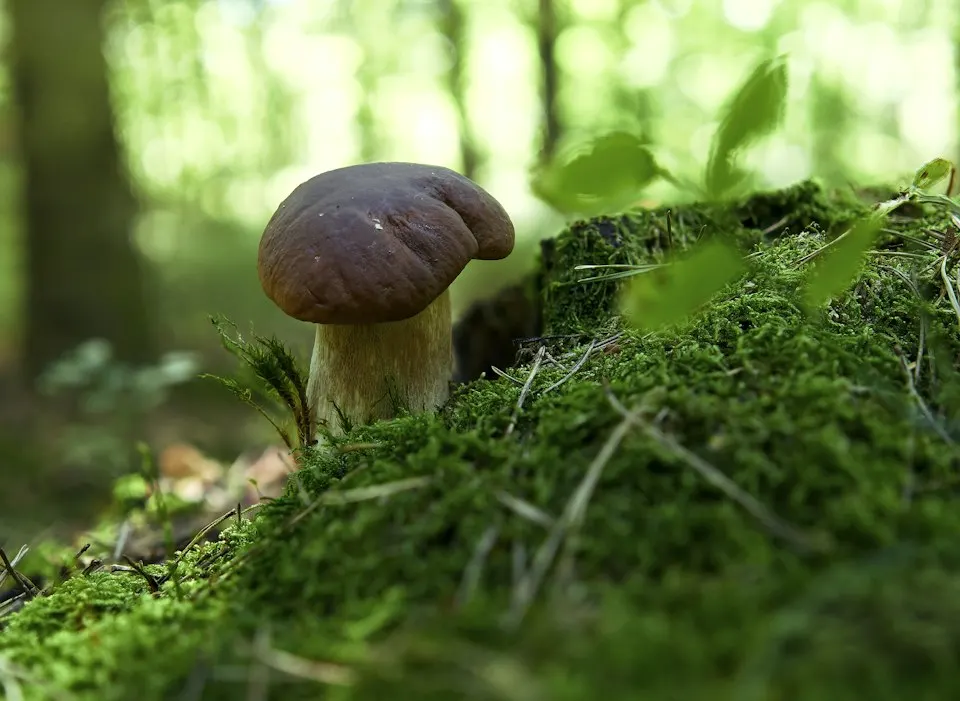
The most serious mushroom poisonings happen to people who ate a mushroom they were not sure about. No app and no forecast can tell you whether the mushroom in your basket is safe. Only a person with the right qualifications can.
Rules you do not bend
- Pick only mushrooms you know for certain. If you have even a shadow of doubt, leave it in the forest.
- Do not pick very young, very old, wormy, rotting or animal-chewed specimens.
- Carry mushrooms in a wicker basket, not a plastic bag. In a bag they spoil and get crushed.
- Twist or cut the mushroom out with a small knife and take it whole, including the base of the stem.
- Sort them at home the same day. Keep them in the fridge, ideally at 2 to 4 °C, and use them within 24 hours.
- Do not eat mushrooms raw. Always cook them.
- Eat a species that is new to you in a small portion first, even if an expert has confirmed it.
Apps and the internet are not enough
A mushroom identification app looks at a photo. It cannot see the underside of the cap, the base of the stem, the smell, or the place the mushroom grew in. A phone photo taken in a forest is often blurred too. Use apps and field guides as an aid, but do not let them decide what goes on your plate.
Home tests such as boiling with an onion or a silver spoon do not detect poisons. Cooking does not destroy the toxins of the most dangerous fungi.
Free sanitary inspectorate points
In the season many sanitary-epidemiological stations run mushroom advice points (punkty grzyboznawcze). Mushroom classifiers and experts work there. Checking mushrooms for your own use is free.
- Bring the mushrooms whole, with the base of the stem. Caps alone are not enough.
- Bring them in a basket, ideally straight after you leave the forest or the next morning.
- The expert may reject mushrooms that are old, rotten, dried, slug-eaten or crushed.
- The specialist rejects any specimen that raises doubt.
Opening hours and addresses differ by town and year. Check the website of your local sanitary-epidemiological station (PSSE) or phone them.
Who should avoid mushrooms
The sanitary inspectorate advises that children, pregnant and breastfeeding women, older people and people with digestive disorders should not eat mushrooms. Mushrooms are hard to digest and put a strain on the body.
Symptoms of poisoning
The first symptoms are usually nausea, vomiting, stomach pain and diarrhoea. They look like food poisoning, so they are easy to brush off. They can start a few hours after the meal, and sometimes more than ten hours after.
The most dangerous fungi cause a false improvement after the stomach phase, roughly 12 hours in. During that time the poison keeps damaging the liver and kidneys. Serious organ damage shows up after a few days. No symptoms in the first hours does not mean there was no poisoning.
What to do if you suspect poisoning
- Call 112. The dispatcher will give you instructions and send an ambulance if the condition is serious. You can also contact a poison centre (ośrodek toksykologiczny).
- Go to hospital. Do not wait for the symptoms to get worse.
- Take with you the leftovers of the meal, raw mushrooms from the same batch and, if you can, a sample of vomit in a sealed bag. It helps the doctors to work out the species.
- Do not give milk or alcohol. They speed up the absorption of toxins.
- Do not give medicine for "indigestion" unless a doctor advises it.
- Do not induce vomiting yourself unless the dispatcher or a doctor tells you to. Medical sources differ here, so follow the dispatcher's instructions.
Everyone who ate the same meal should see a doctor, even without symptoms. Tell the dispatcher about it.
Where to learn
Learn to recognise mushrooms from an experienced picker, on a course or from a mushroom expert. No guide on a website can replace that. We show the season in what grows in which month, and conditions for going out in the mushroom forecast.
Do not miss the next window
The best windows last a few hours: after a storm, after rain, on a clear night with an active Sun. Sign up and we will email you when the index at your spots goes above 60.