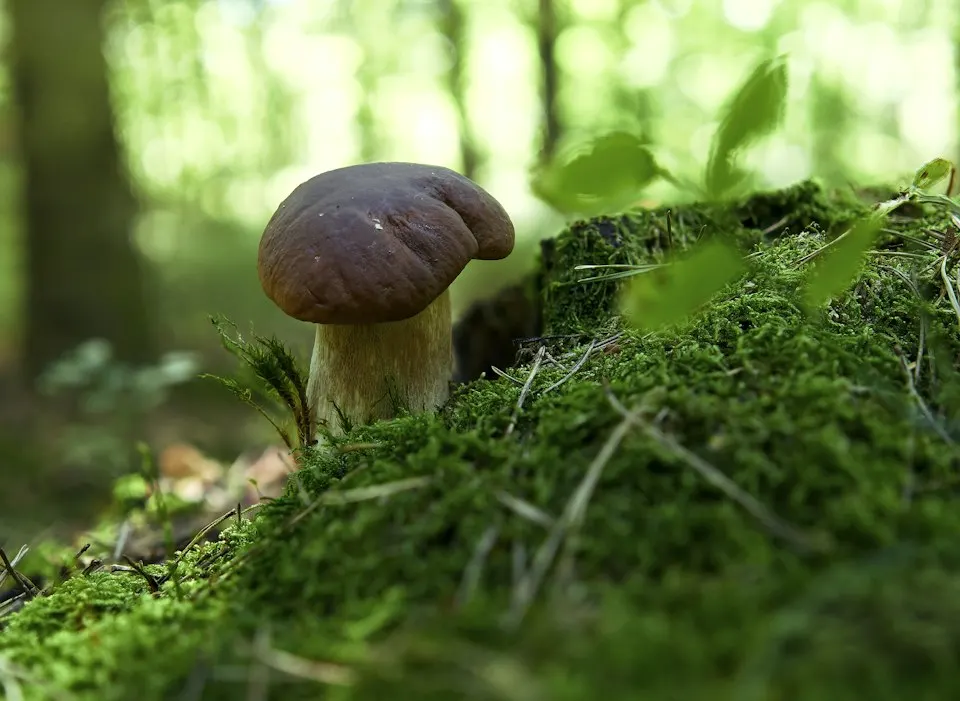
In Polish state forests you can pick mushrooms for your own use without a permit. You cannot do it in national parks, in nature reserves, or in places where entry is banned. Below are the concrete rules.
State forests
The Forest Act (ustawa o lasach) says that forests owned by the State Treasury are open to the public. Collecting forest produce, including mushrooms, for your own needs is allowed. The Act sets no limit in kilograms at that point. Collecting on an industrial scale needs a contract with the forest district (nadleśnictwo).
Where entry is permanently banned
Article 26 of the Forest Act takes the following out of public access, among others:
- forest cultures up to 4 m tall, meaning young plantations,
- experimental plots and seed stands,
- wildlife refuges and springs,
- areas at risk of erosion.
Such places are marked with signs saying "zakaz wstępu" (no entry). Cultures up to 4 m do not have to carry a sign, so simply do not push into dense young plantations.
Temporary bans in drought and fire risk
The local forester (nadleśniczy) can close a forest for a set time when the fire risk is high. You will find the notice on signs at the forest entrances and on the forest district's website. In a dry spell, check the notice before every trip. The ban covers the whole forest, not only picking.
National parks and nature reserves
Picking mushrooms is banned in national parks. In nature reserves the same ban usually applies. The details are set by the act that creates each reserve, so always read the sign at the entrance. You will find park and reserve boundaries on the signs at entrances and on maps from the forest districts and the parks.
Landscape parks do not have such a general ban. They can, however, contain reserves. To see how this looks in your region, open the regional overview.
Private woods and closed areas
The owner of a forest that is not State Treasury land can ban entry and mark the forest with a sign. If there is a sign, do not enter. If there is none and you are unsure, ask the owner or the municipal office (urząd gminy).
Military areas, training grounds and the border strip have their own entry limits. Near the Belarusian border extra zones apply, so check current notices from the Border Guard before you go.
What else the Act forbids
- Destroying fungi and mycelium. Twist or cut the mushroom out and do not dig up the litter.
- Raking up or collecting forest litter.
- Collecting forest produce in places marked as banned.
- Camping outside designated places.
- Lighting a fire outside designated places, in the forest and within 100 m of its edge.
- Driving on forest roads that are not marked as open to traffic.
Protected species
Some fungi are legally protected, among them the devil's bolete (borowik szatański) and the royal bolete (masłoborowik królewski). You must not pick or destroy them. The species most people pick, such as cep (prawdziwek) and chanterelle (kurka), are not protected. The full list is in the regulation on the species protection of fungi.
Fines
For entering a closed area, or for picking mushrooms in a national park or reserve, you can get a warning or a fine. Fines for these offences run to a few hundred zloty, and the upper limit for an on-the-spot fine is 500 zł. If the case goes to court, the penalty can be higher. Not knowing about a ban does not excuse you.
Selling mushrooms
Picking for yourself is not the same as trading. Wild mushrooms may be sold to consumers only in a shop or at a market, and only with a certificate (atest) issued by a qualified mushroom classifier or grzyboznawca. Prices, rules and taxes are in our guide selling wild mushrooms in Poland.
To see whether it is worth heading out now, open the mushroom forecast.
Do not miss the next window
The best windows last a few hours: after a storm, after rain, on a clear night with an active Sun. Sign up and we will email you when the index at your spots goes above 60.