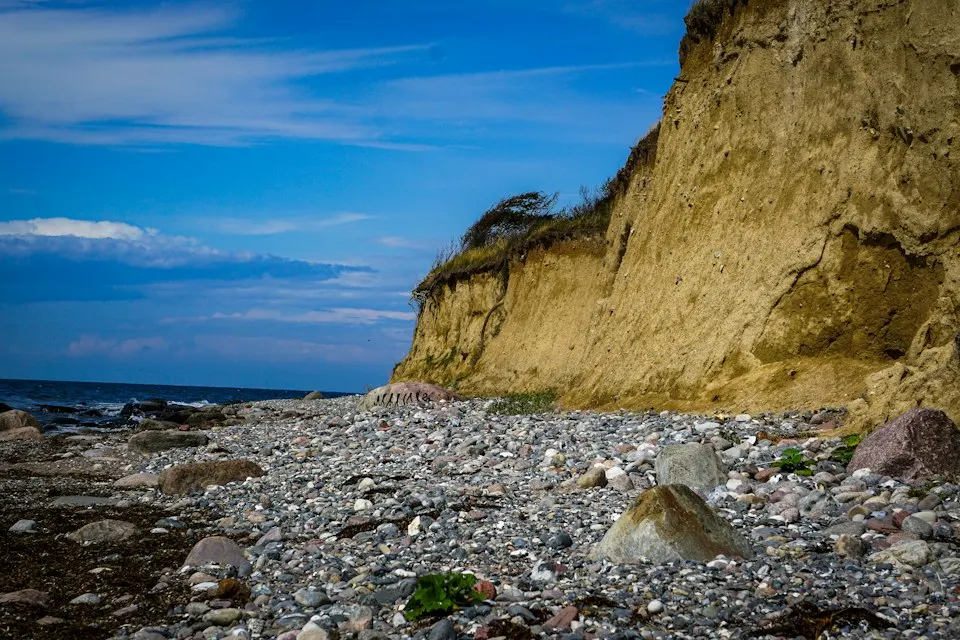
Flint is the most common stone on Baltic beaches. Many flints hold a fossil, because they formed in Cretaceous mud, around animals and sponges. You only need to know how to look.
Why flint holds fossils
Flint formed in Cretaceous sediment on the floor of an ancient sea. Silica collected around organisms and in animal burrows. That is why flint kept shapes that dissolved long ago in the soft chalk. The ice sheet tore flints out of the Cretaceous bedrock and pushed them south, and today the sea washes them out of the cliff clay.
Sea urchins
The easiest to recognise are the Cretaceous irregular sea urchins. They are shaped like a bowl, a helmet or a small dome, from a few to a dozen or so centimetres across.
- Five rays. On top you can see five bands of tiny dots running from the apex like the rays of a star. This is the surest sign.
- An internal cast. Often only a flint cast remains. It is smooth, with no shell, but the shape and the five-fold symmetry still show.
- The base. The underside can be flat, with the mouth opening shifted to one side.
An ordinary lumpy flint has no symmetry. If you see five repeating bands, it is a sea urchin.
Sponges
Fossil sponges are less obvious. Look for cup, finger or mushroom shapes. The surface can be porous, as if pitted with small holes, or carry a delicate mesh. In the gravel you also come across tiny balls a few millimetres across. They are often miniature sponges.
Flints shaped like a branching tube are usually filled animal burrows, not sponges. They are no less interesting, but they are a different kind of fossil.
Bryozoans and other small things
On the surface of some flints you can see delicate nets or twigs. These are bryozoans, colonies of tiny animals. They show up well under a 10x lens.
How to check a stone
- Wet it. Wet flint shows the pattern more clearly.
- Look from the side. Light from the side picks out the bands of dots and the pores.
- Look for symmetry. Natural flint has none. A sea urchin does.
- Do not break stones at the foot of a cliff. The chips are sharp, and the face can slump. If you do split a stone, do it well away from the cliff, with safety glasses and gloves.
Beware of illusions. Holes and flakes in a stone are often just weathering, not a fossil. A real fossil has a repeating, symmetrical pattern.
Where to look
Flints are everywhere a cliff is made of glacial till. The best collections come from West Pomerania: Trzęsacz, Rewal, Niechorze and Pobierowo. Ustronie Morskie and Jastrzębia Góra are good too. Search the gravel bands after a storm. Pick your day with the fossil forecast.
You can read about belemnites, which often lie next to flints, in the guide belemnites, the thunderbolt stones. The collecting rules are in the rules guide.
Do not miss the next window
The best windows last a few hours: after a storm, after rain, on a clear night with an active Sun. Sign up and we will email you when the index at your spots goes above 60.