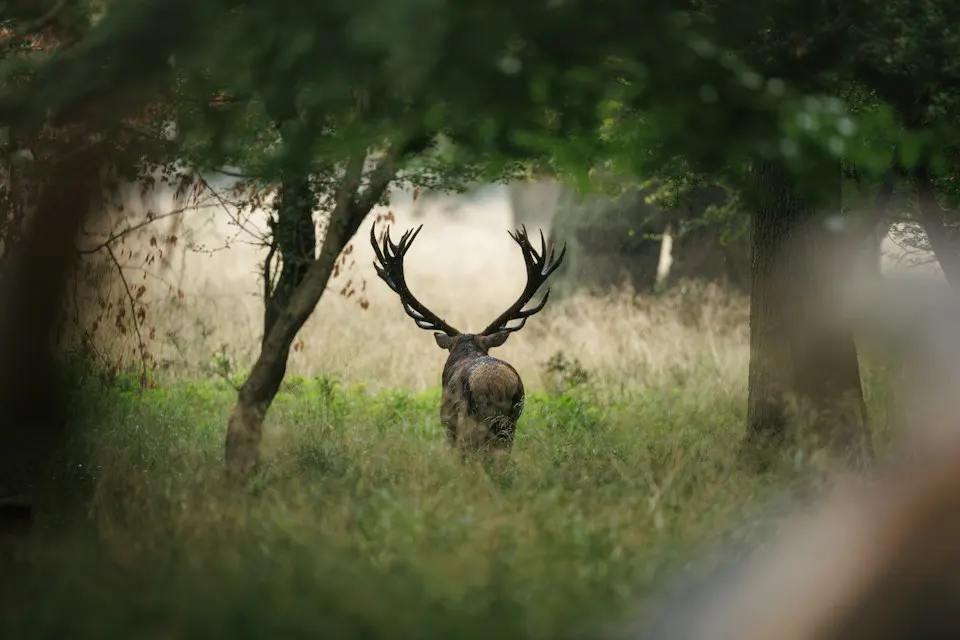
Good wildlife watching leaves the animal doing what it was doing before you arrived. Polish law points the same way: it bans disturbing many species, and national parks and reserves add their own bans. Below are the key rules and practical habits.
Disturbing protected species
Article 52(1) of the Polish Nature Conservation Act lists bans that can apply to protected animals. They include deliberate scaring or disturbance (point 12), disturbance at roosts, in the breeding season and at feeding sites of migrating or wintering flocks (point 13), and photographing, filming or observing in a way that may scare or disturb them (point 14).
Which bans apply to which species is set by the regulation on species protection of animals. Its § 6 says that species marked (1) in the annex are covered by a ban on deliberate disturbance, species marked (2) by a ban on disturbance at roosts, breeding sites and flock feeding sites, and species marked (3) by a ban on photography, filming and observation that may disturb them. Before you photograph at a nest, check the species' status in the annex.
Protection zones around nests
The regional director for environmental protection (RDOŚ) can set protection zones around refuges, breeding sites and regular haunts of some animals (Article 60(3) of the act). This applies, for example, to white-tailed eagles and black storks. These zones are not marked on the ground, and their locations are not public, precisely to protect the nests. If you find the nest of a large bird of prey, do not go closer and do not publish its location.
National parks and reserves
Article 15(1) of the act bans in national parks and reserves, among other things:
- deliberately disturbing vertebrates and collecting antlers (point 3),
- walking, cycling and riding off marked trails (point 15),
- bringing dogs into strict and active protection areas, except where allowed (point 16),
- disturbing the quiet (point 20) and camping outside marked sites (point 23),
- building structures, except those that serve the park (point 1).
Deliberately breaking these bans can be punished with detention or a fine (Article 127), and so can breaking species protection bans without a permit (Article 131, point 14). Cases go to court under the Code of Procedure for Petty Offences.
Hides and permits
In a national park you cannot put up your own hide without the director's consent, because building structures and leaving trails are banned. Some parks offer their own hides or give consent for photography off the trails. The act treats photography and filming as a form of making the park available (Article 5(22)), and the director may charge for it (Article 12). For example, Drawa National Park, in rules from 2014, listed 100 zł per day for commercial photography from a trail and 150 zł off the trail.
If you want to photograph a protected species in a way that may disturb it, you need a permit for an exemption from the ban. It is issued by the regional director for environmental protection, and in some cases by the General Director for Environmental Protection. In state forests outside parks, agree any permanent hide with the forest district, which manages the land.
Drones
The Polish Aviation Law (Article 124(1)) restricts flights over national parks and reserves. Many parks lie in drone geographical zones. Bieszczady National Park and its buffer zone form zone EP R10, and a 2024 order of the park director bans flights over areas open to visitors. Before every flight, check the zone map at dronemap.pansa.pl. Even where a flight is legal, a drone over a flock of birds may count as disturbance under the act.
Distance in practice
- European bison: at least 50 m, according to Białowieża National Park, better 100 m.
- Seals: do not approach a seal on a beach. Report it to WWF Poland's Blue Patrol on +48 795 536 009.
- Moose: take special care around a cow with a calf in spring.
- Bird flocks: stay in your car or on a tower, do not walk onto the field.
People who scared seals at the Vistula mouth for photos have been fined up to 5,000 zł. For comparison, Yellowstone asks visitors to stay 100 yards from bears and wolves and 25 yards from other animals.
Good habits
- Do not feed wild animals and do not put out bait to attract them.
- Do not play bird calls, especially in the breeding season.
- Do not publish the locations of nests, dens and breeding sites.
- Do not block an animal's escape route and do not surround it with several people.
- Keep your dog on a lead, or leave it at home.
The Polish Society for the Protection of Birds (OTOP) describes similar principles in its guide to ethical nature photography. You will find the rules for specific places on the spot pages, for example Mewia Łacha or Białowieża.
Sources
- Polish Nature Conservation Act, consolidated text (Dz.U. 2026 item 1315, in Polish)
- Article 52 of the Nature Conservation Act (LexLege, in Polish)
- Regulation on species protection of animals (Dz.U. 2022 item 2380, in Polish)
- Drone flights in Bieszczady National Park (dlapilota.pl, in Polish)
- Photography rules and prices, Drawa National Park
- Birds and seals at the Vistula mouth (OKO.press, in Polish)
- Yellowstone safety and wildlife distances (US National Park Service)
- Ethical nature photography (OTOP, in Polish)
Do not miss the next window
The best windows last a few hours: after a storm, after rain, on a clear night with an active Sun. Sign up and we will email you when the index at your spots goes above 60.