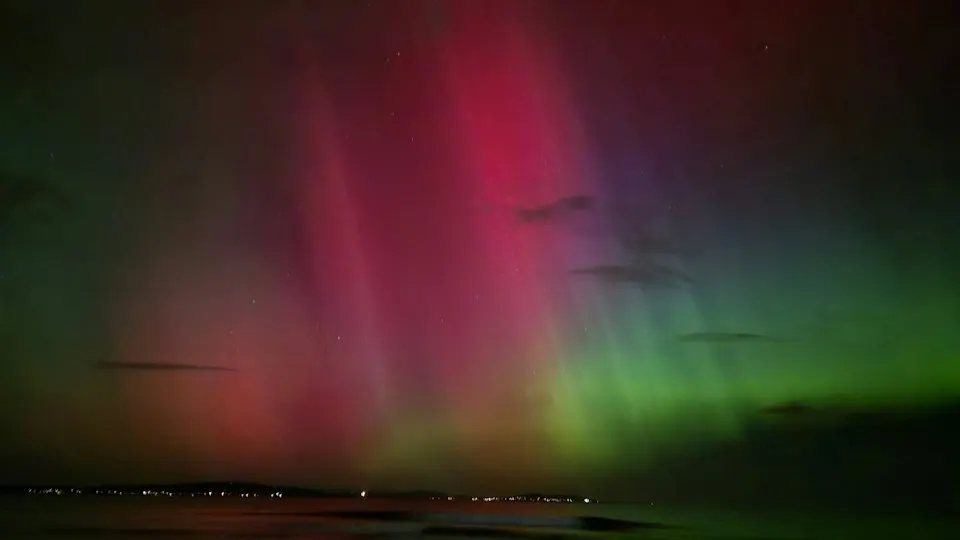
Kp is a number from 0 to 9 that tells you how disturbed Earth's magnetic field is. The higher it is, the further south the aurora reaches. In Poland things get interesting from Kp 5, and the naked eye usually sees the aurora from Kp 6 or 7.
What Kp is
The Kp index is built from magnetometers spread around the world. They measure how far the magnetic field departs from its quiet level over three hours. NOAA averages data from 13 observatories at 44–60° geomagnetic latitude. 0 means calm and 9 means an extreme storm.
There are two versions. The preliminary Kp from NOAA uses whole numbers from 0 to 9, and its chart refreshes every minute. The final Kp from GFZ in Potsdam has 28 values, such as 4-, 4 and 4+, and is used for archives and research.
The G-scale: a storm starts at Kp 5
NOAA calls only Kp 5 and above a geomagnetic storm. The G-scale has five levels:
- Kp 5, G1, minor storm. On average about 1,700 such storms per solar cycle.
- Kp 6, G2, moderate. About 600 per cycle.
- Kp 7, G3, strong. About 200 per cycle.
- Kp 8, G4, severe. About 100 per cycle.
- Kp 9, G5, extreme. About 4 per cycle, 4 days in total over roughly 11 years.
Kp 0–4 is level G0, which means no storm. At Kp 4 the aurora can still be seen in Scandinavia, but not here.
Which Kp you need in Poland
The list below is a rule of thumb from National Geographic Polska. It assumes good conditions: a night without cloud, a dark place and an open horizon to the north.
- Kp 0–3: no realistic chance.
- Kp 4–5: a camera can catch a faint violet glow low over the northern horizon, mainly from the coast.
- Kp 6: northern and central Poland. The aurora is sometimes visible to the naked eye as a pink or red glow.
- Kp 7: the whole country, and possible even at the southern edge.
- Kp 8–9: aurora across the country, sometimes right overhead.
The SpaceWeatherLive table, which describes where the auroral oval sits, puts Warsaw at Kp 7 and Hamburg at Kp 6. That fits the rule that the further north you are, the lower the Kp you need. This is why our aurora forecast scores each place separately.
What Kp does not tell you
- Kp is global. It describes the whole Earth, not the sky above you. Cloud over Poland does not affect it.
- Kp is averaged over three hours. The aurora flares and fades within that time, so short brightenings can be stronger than the number suggests.
- A forecast can be too high or too low. A forecast several days ahead is an estimate. Only data from the satellites ahead of Earth shows what is really arriving.
Where to check Kp
- NOAA 3-day forecast. It is issued every 12 hours, at 00:30 and 12:30 UTC. In Poland that is 1:30 or 2:30 and 13:30 or 14:30, depending on winter or summer time.
- NOAA Aurora 30-minute forecast. The OVATION model shows where the aurora will appear in 30 to 90 minutes. That is how long the solar wind takes to travel from the satellites to Earth.
- The live Kp chart. It refreshes every minute and shows the estimated Kp for the current three hours.
- Our forecast. It adds cloud cover and the Moon for specific places.
At higher Kp the direction of the magnetic field in the solar wind also matters. If its Bz component is negative, meaning it points south, the wind's field links up with Earth's field and the storm strengthens. You will find Bz among the solar wind data on the NOAA SWPC site.
How to use this
With a forecast of Kp 5, head for the coast and take a camera. With Kp 6 or 7, go somewhere dark, including inland. With Kp 8 or 9, a good northern horizon anywhere is enough, even in the south. We describe all the conditions in the guide to the northern lights in Poland.
Do not miss the next window
The best windows last a few hours: after a storm, after rain, on a clear night with an active Sun. Sign up and we will email you when the index at your spots goes above 60.