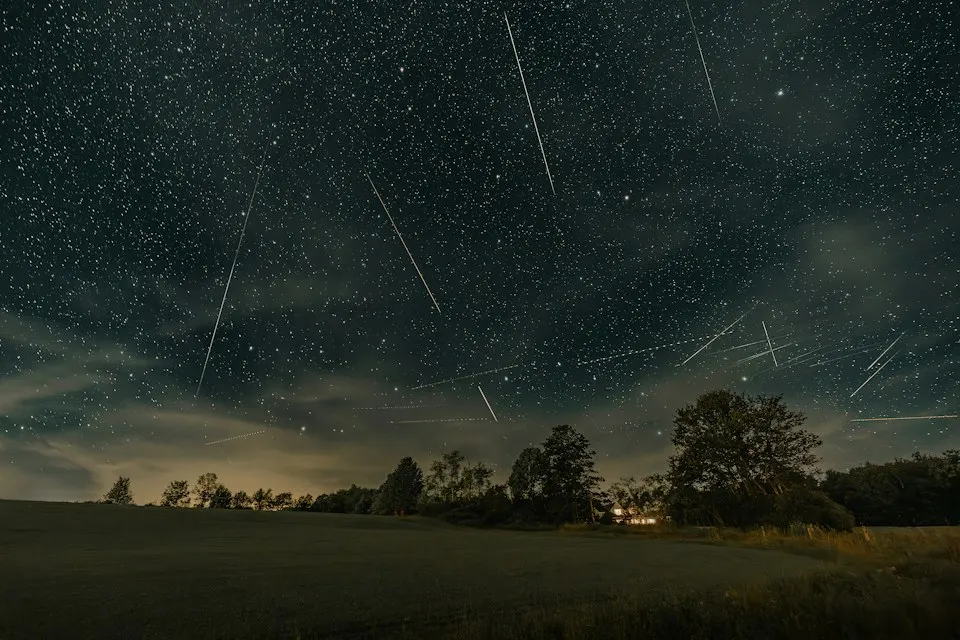
A meteor shower is a few nights a year when Earth passes through dust left by a comet or an asteroid. The number quoted in calendars is the ZHR, the hourly rate under ideal conditions. In practice you usually see a third to a half of that number, and even fewer under a bright Moon.
What ZHR means and why you see fewer
The ZHR (zenithal hourly rate) is the number of meteors one observer would see in an hour if the shower radiant were straight overhead and the sky were dark enough to show stars down to magnitude 6.5. Those conditions almost never happen, so the number you actually count is lower. Three things decide it:
- Radiant altitude. The ZHR is multiplied by the sine of the radiant altitude. A radiant 30° above the horizon gives half the meteors, at 10° only a sixth.
- Sky brightness. Each magnitude of brighter sky means fewer meteors. How many fewer depends on the shower: the IMO gives each one a population index r, usually between 2 and 3. With r = 2.5, a sky one magnitude brighter gives 2.5 times fewer meteors.
- Clouds and obstacles. If trees or clouds hide a quarter of the sky, you lose roughly a quarter of the meteors.
An example for the Geminids (ZHR 150, r = 2.6). In Poland the radiant stands at about 70° around 2 am. Under a dark sky that shows stars to magnitude 6 you will see about 85 meteors an hour. On the edge of a town, with a limit around magnitude 5, only about 35. In a bright suburb, a handful to a dozen or so.
How our forecast works
For every night and every spot we take the active showers from the IMO working list, work out the altitude of each radiant hour by hour and turn the ZHR into the number you can realistically see. We include the Moon phase and altitude, cloud cover from Open-Meteo and whether it is fully dark. The darkness of the spot itself is estimated on the Bortle scale. The result is an estimate, not a promise.
Main showers: November 2026 to December 2027
| Shower | Peak | ZHR | Moon at the peak |
|---|---|---|---|
| Leonids | 17/18 November 2026 | about 15 | near first quarter, sets around midnight |
| Geminids | 13/14 December 2026 | 150 | thin crescent, very good conditions |
| Ursids | 22 December 2026 | 10 | nearly full, poor conditions |
| Quadrantids | 4 January 2027, 03:25 UT | 80 (60 to 200) | just before new Moon, very good conditions |
| Lyrids | 23 April 2027 | 18 | three days after full Moon, worst conditions of the year |
| η-Aquariids | 6 May 2027 | 50 | good, but from Poland the radiant only rises before dawn |
| Perseids | 12/13 August 2027 | 110 or more | between first quarter and full, best after moonset |
| Orionids | 22 October 2027 | 20 | waning Moon, a problem in the second half of the night |
| Leonids | 17 to 20 November 2027 | 15, possible rises to 40–50 | gibbous Moon, a problem |
| Geminids | 13/14 December 2027 | 150 | full Moon, very poor conditions |
| Ursids | 22/23 December 2027 | 10 | good conditions |
Dates and numbers come from the IMO calendars for 2026 and 2027. Add one hour to UT for Polish winter time and two hours in summer. For the 2027 Perseids the IMO gives the peak on 13 August between 08:00 and 10:00 UT, which is daytime in Europe, so in Poland the best views are before dawn on 12 and 13 August. For the 2027 Leonids, models point to several short, possible rises between 17 and 20 November, but their strength is uncertain.
When to go out
- After midnight. Most showers are best between midnight and dawn, because the radiant is higher and the side of Earth facing its orbital motion sweeps up more meteoroids.
- Exceptions. The Geminids give plenty of meteors from the evening, because the radiant rises at dusk. The Draconids are best in the evening.
- The night before and after. Many showers have a broad peak, so the night before or after can also be good, especially when the peak night has a full Moon or clouds.
How to watch
- Leave town. It helps more than any equipment. Dark spots are listed in our meteor forecast.
- Give your eyes 20–30 minutes. That is how long they need to adapt to the dark. Avoid your phone screen, or dim it and switch on a red filter.
- Lie down. A recliner or a mat lets you look up without a stiff neck. Bring a sleeping bag, because even in August it gets cold after midnight.
- Look halfway between the horizon and the zenith. You do not need to stare at the radiant. Meteors appear all over the sky, and those farther from the radiant leave longer trails.
- No binoculars or telescope. They narrow your view, and meteors are too fast.
- Give it at least an hour. Meteors come in bursts, and a quiet quarter of an hour is often followed by several in a row.
If you want to take pictures, read how to photograph meteors.
Sources
- IMO Meteor Shower Calendar 2027 (PDF)
- IMO Meteor Shower Calendar 2026 (PDF)
- Zenithal hourly rate, definition and formula (Wikipedia)
- American Meteor Society: FAQ
Do not miss the next window
The best windows last a few hours: after a storm, after rain, on a clear night with an active Sun. Sign up and we will email you when the index at your spots goes above 60.