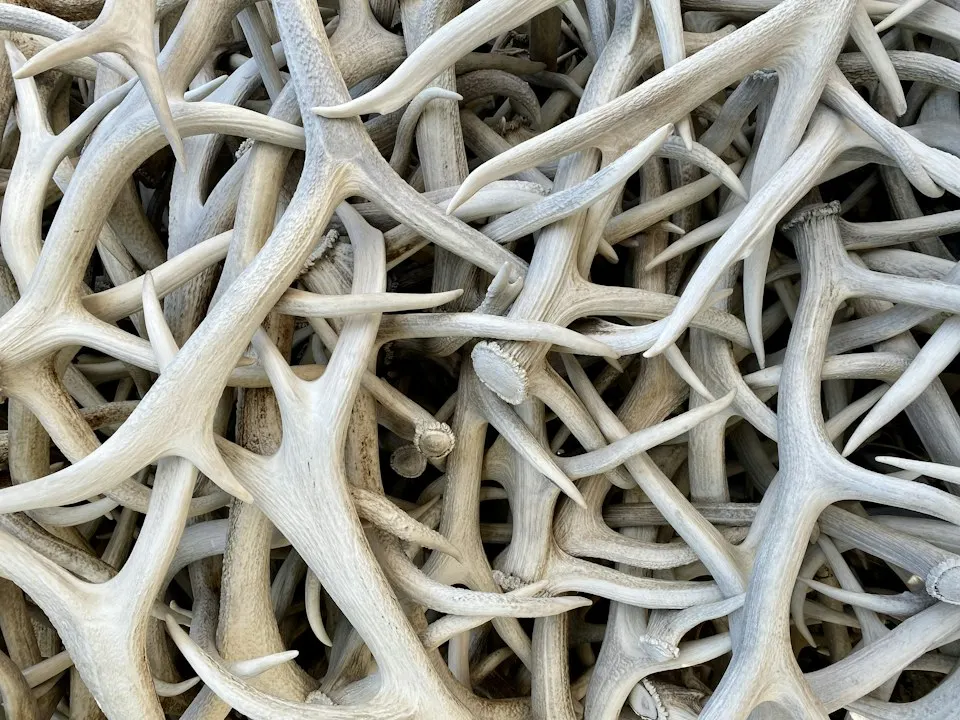
Sheds lie where animals survived the winter, and we look for them when animals are at their weakest. That is the main ethical problem with this hobby. The good news is that a few simple rules almost remove it.
Why late winter is critical
In winter deer eat little, and the food is poor. They live mostly on fat stored in autumn. By late winter those reserves are running out. Hinds and cows are pregnant, and stags and bulls spent a lot of energy during the rut.
Every escape from a person or a dog costs energy the animal cannot quickly replace. Running through deep snow costs many times more than walking. One disturbance rarely kills, but many disturbances a week on the same winter range can decide whether weaker animals survive and how fit the young are born.
That is why US states close winter range. Colorado bans collecting sheds on public land west of I-25 from January to the end of April to protect wintering big game and sage-grouse from disturbance. Utah requires an ethics course from anyone collecting sheds from January to May.
Rule one: do not go where the animals are
- If you see animals, go back the way you came and search elsewhere.
- If you see fresh tracks, droppings and beds, animals are close. Come back in a week or two.
- Keep the wind in your face so animals cannot scent you.
- Never follow an animal that still has antlers, waiting for them to drop. That is harassment, and in many places it is illegal.
- Avoid early morning and dusk, when animals come out to feed.
Rule two: stay out of refuges
Wildlife refuges are where animals rest and hide by day. In Polish state forests they are marked with a no-entry sign (Art. 26 of the Forest Act). It is tempting to go in, because sheds probably lie there. Do not. A refuge is closed precisely so that animals have peace. You can find sheds from the edge of a refuge by walking its boundary once the animals have moved away.
Rule three: dogs on a leash
In Polish forests you may not let dogs run loose (Art. 30(1)(13) of the Forest Act). Even a calm dog that does not chase leaves scent and noise, and animals react to a dog as to a predator. A dog chasing a pregnant hind through snow can kill her without biting, through sheer exertion.
In the US, dogs trained to find sheds are popular. They work by scent and really help. In Poland they may work only on a leash, and the owner is still responsible for any disturbance. In the US, check local leash rules and keep the dog under control near wildlife.
Rule four: do not drive in
A car, quad or motorbike in the forest is more than noise. In Poland, motor vehicles may use only public roads and roads marked as open in forests. Roads behind a barrier are closed to collectors too. In the US, respect seasonal road and travel closures on winter range. Leave the car at a trailhead or forest car park and walk.
Rule five: respect the people who manage the land
In Poland hunting clubs lease hunting districts, feed game and pay for game damage to crops. Many do not mind collectors, but they dislike people near feeders, high seats and food plots. Do not sit in high seats, do not take salt from licks and do not leave litter. If you search one district regularly, introduce yourself to the club. You will often learn when and where searching bothers the animals least.
Much of the forest in Poland is state-owned, so the local forest district is a good place to ask about current entry bans and driven hunts. In the US, the state wildlife agency and the land manager (Forest Service or BLM) publish closures.
Rule six: do not take what is not a shed
- Do not break antlers off the skull of a dead animal. That is not a shed. Report the find to the hunting club or forest district in Poland. In Utah, report a deadhead through the DWR instead of moving it.
- In Poland report a dead wild boar to the district veterinary officer or the municipality because of African swine fever. Do not touch it.
- In national parks and nature reserves, do not take even a single tine.
Drones and trail cameras
A drone over winter range disturbs animals as much as a person, often more. Do not use a drone to search for sheds over ground where animals are standing. Flying drones in national parks and reserves is usually banned or needs a permit. Set up trail cameras only with the consent of the landowner or land manager.
Rule seven: do not be first at any cost
The race for the first sheds pushes people into the ground before animals have left it. Someone who comes two weeks later finds only a little less and does not drive animals off winter range. Our shed antler forecast shows good days, but it does not know whether animals are standing at a given spot. Only you can judge that, on the ground.
Quick checklist
- Animals in sight: back off.
- Refuge or plantation sign: do not enter.
- Dog: always on a leash.
- Car: leave it at the car park.
- Dead animal: report it, do not take it.
- National park or reserve: collect nothing.
Sources
- Polish Forest Act, consolidated text Dz.U. 2024 item 530
- Polish Hunting Law, consolidated text Dz.U. 2023 item 1082
- Colorado Parks and Wildlife, protecting winter range
- Utah DWR, Antler Gathering Ethics Course
- Idaho Fish and Game, advice for shed hunters
Do not miss the next window
The best windows last a few hours: after a storm, after rain, on a clear night with an active Sun. Sign up and we will email you when the index at your spots goes above 60.