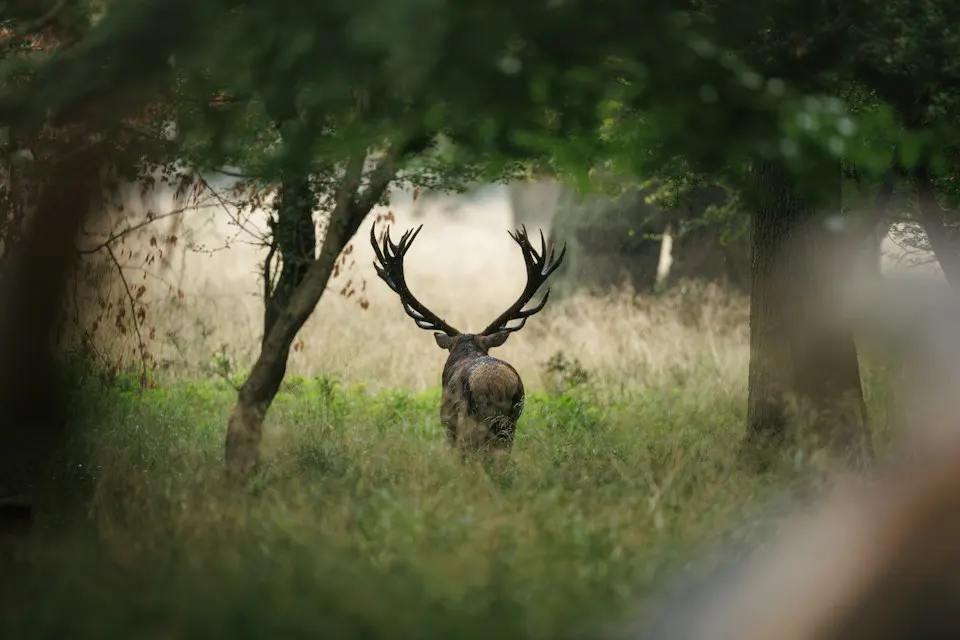
The rut is the mating season of the red deer. In Poland it usually runs from mid-September to mid-October, and it is loudest around the turn of September and October. Stags roar mostly at dusk, at night and at dawn, so that is when to stand at the edge of a meadow and listen.
What happens during the rut
Mature stags gather groups of hinds and defend them against rivals. The roar is a signal to other stags and to the hinds. When two stags are evenly matched, they sometimes fight with their antlers. The animals are less wary than usual, but they still react quickly to human scent and movement.
The peak does not fall in the same week every year. It depends on the weather and the region. In the mountains and in the north-east it can be a little later than in western Poland. That is why our forecast looks at half-months, not just months.
What you actually hear
A stag's roar is a deep, drawn-out sound that carries for several kilometres in good weather. When several stags are close, they answer each other, and the roars get shorter and choppier. Sometimes you hear the dry clack of antlers as two stags clash in the forest. Hinds are mostly quiet, but when something alarms them they give a short, sharp bark. If you hear it, the group has seen or smelled you. Stand still and do not move closer.
Which weather helps
The best is a cold, calm, clear morning after a clear night. When the temperature drops, stags roar more readily, and sound carries far in cool, still air. Strong wind drowns out the roar and spreads your scent. Heavy rain also spoils the session.
- Temperature: a cold morning, ideally a few degrees above zero or a light frost.
- Wind: light, and you stand so that it blows from the animals towards you.
- Sky: clear or slightly cloudy, no rain.
- Visibility: valley fog does not stop you listening, but it makes photos harder.
Our wildlife-watching forecast scores these conditions for the morning and evening hours.
Where to listen in Poland
Red deer live in almost every large forest, so you can hear the rut in many regions. The most famous area is the Bieszczady Mountains. In the San valley, for example near Muczne, you can hear roaring from roads and meadow edges outside the national park. Białowieża Forest is also good, where deer come out onto the meadows around villages, as are Kampinos and Roztocze.
Abroad, a well-known place is Scotland's Cairngorms National Park, where the rut runs from late September into October.
How to listen without disturbing
Arrive before dawn or an hour before sunset. Stand in one place at a meadow edge, by a road or on a public viewing platform. Do not walk towards the roar, because in the dark it is easy to end up between the hinds and the stag. Bright binoculars, such as 8x42, will show you more than walking around.
- Whisper, silence your phone and do not slam car doors.
- Do not shine a torch onto the meadow and do not use flash.
- Do not use a deer call or play recorded roars. In a national park this can count as disturbing animals.
- If a deer notices you and starts to move away, stay where you are and let it go.
Rules you need to know
The red deer is a game species, not a protected species. That does not mean anything goes. In national parks and reserves, Article 15 of the Polish Nature Conservation Act bans deliberate disturbance of vertebrates, collecting antlers and walking off marked trails. In forests outside parks you may walk, but keep out of areas with a no-entry sign.
Drone flights are banned in Bieszczady National Park, which lies in restricted zone EP R10. For more on the rules, read wildlife-watching ethics and the law in Poland.
What to bring
Warm layers, a hat and gloves, because you stand still in the cold. A flask of tea, a headtorch with a red light for the walk back to the car, and binoculars. If you take photos, bring a tripod and a long lens, but do not close the distance for a better frame. A good rut photo is often a stag's outline in the fog, from far away.
A plan for one morning
The evening before, check the wind and temperature forecast. Leave so that you are in place an hour before sunrise. Turn off the engine, wait a few minutes and listen. When it gets light, scan the forest edge with binoculars. Head back to the car when the sun clears the trees, because that is when deer usually move back into the forest.
Sources
- Polish Nature Conservation Act, consolidated text (Dz.U. 2026 item 1315, in Polish)
- Drone flights in Bieszczady National Park (dlapilota.pl, in Polish)
- Białowieża Forest, how to watch wildlife (National Geographic Polska, in Polish)
- Cairngorms National Park
Do not miss the next window
The best windows last a few hours: after a storm, after rain, on a clear night with an active Sun. Sign up and we will email you when the index at your spots goes above 60.