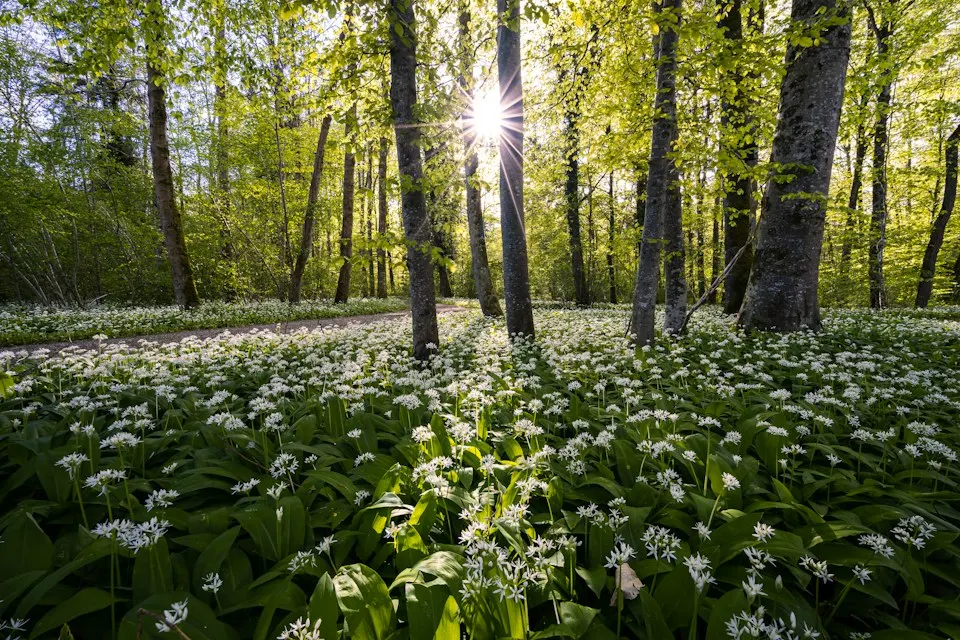
One rule matters more than any other: never eat a wild plant you cannot identify with 100% certainty. Some of Europe's most poisonous plants grow in the same places as popular herbs and look almost the same when young. Poisoning by lily of the valley, autumn crocus, hemlock or water hemlock can kill.
Rules that save lives
- Identify by several features at once: leaf shape, how it grows from the ground, stem, flower, smell and habitat. One feature is not enough.
- Check every single leaf or plant. Lily of the valley can grow right inside a patch of wild garlic.
- Do not trust smell alone. After a few garlic leaves your hands smell of garlic, and every next leaf seems to smell of it too.
- Do not pick umbellifers (white umbrella-shaped flower heads, finely divided leaves) unless you are a botanist. This family includes Europe's deadliest plants.
- A plant ID app is a hint, not a verdict. Apps are least reliable with young leaves.
- Never give unknown plants or berries to children to play with or eat.
Wild garlic, lily of the valley, autumn crocus, false hellebore
| Plant | How it grows | Features |
|---|---|---|
| Wild garlic | Each leaf rises from the ground on its own thin stalk | Soft leaf, matt underneath, smells of garlic when crushed. White round flower head. |
| Lily of the valley (deadly) | Usually two leaves wrapped around each other at the base, without separate stalks | Stiffer leaf, glossy underneath, no garlic smell. White bells on one stem. |
| Autumn crocus (deadly) | Several leaves in a tuft straight from the ground, no stalks, around a seed capsule | Thicker, glossy leaves, no smell. Grows in damp meadows and flowers purple in autumn. |
| White false hellebore (deadly) | A thick stem with leaves spiralling up it, in mountains | Broad leaves, clearly pleated along the veins. |
| Lords-and-ladies (toxic) | Leaves on long stalks from the ground | Arrow-shaped leaf with net-like veins, sometimes with dark spots. |
In Poland wild garlic is protected, so cultivated plants are the simplest way to avoid a mistake there. Elsewhere, pick it leaf by leaf, never by the handful.
Hemlock and water hemlock versus elder, wild carrot and cow parsley
Hemlock (Conium maculatum) and cowbane, or northern water hemlock (Cicuta virosa), are umbellifers with white flower heads. They are among the most poisonous plants in Europe. Hemlock has a smooth, hollow stem with purple blotches and a nasty, mousy smell when crushed. Cowbane grows in and beside water, and its thick rootstock has hollow chambers divided by cross-walls. In Britain and France, hemlock water dropwort (Oenanthe crocata) is just as dangerous. In North America, western and spotted water hemlock (Cicuta douglasii, Cicuta maculata) play the same role.
People confuse these with wild carrot, cow parsley, ground elder and elderflower. Elder, however, is a woody shrub with bark, not a soft herb. If a white umbel grows on a soft, green stem, do not pick it. Wild carrot has a hairy stem and often one dark floret in the middle of the head, but do not treat that as proof. The safest choice is not to pick wild umbellifers at all.
Foxglove versus comfrey and borage
Before it flowers, foxglove forms a rosette of soft, hairy leaves. At that stage it looks like comfrey, borage and mullein. Foxglove is deadly. Its leaves have small rounded teeth and a raised net of veins underneath, and it lacks the rough, bristly hairs of comfrey. Because rosettes are so hard to tell apart, do not pick hairy rosettes unless you have seen the plant flower in that spot before and know it for certain.
Berries: deadly nightshade, yew, bittersweet
- Deadly nightshade: glossy black berries the size of a cherry, one at a time, on a star-shaped calyx. A herb up to 1.5 m tall, in clearings and felling sites. Dangerous for children, who mistake it for bilberry.
- Yew: a red, fleshy cup with a visible dark seed, and flat, soft needles. The needles and seeds are poisonous.
- Bittersweet nightshade: red oval berries in drooping clusters on a climber with purple flowers.
- Red-berried elder and dwarf elder: red-berried elder has red berries that must never be eaten raw, and dwarf elder has black berries in upright clusters and is considered poisonous.
Giant hogweed and Sosnowsky's hogweed
These are giant umbellifers, 3 m tall or more, with flower heads half a metre wide. Their sap, combined with sunlight, causes severe skin burns with blisters that take weeks to heal and leave marks. Do not touch them with bare hands, do not cut them without protective clothing, and do not let children use the hollow stems as tubes. After contact with the sap, wash the skin with soap and water as soon as you can and keep it out of the sun.
If poisoning happens
- Call the emergency number (112 in the EU, 999 in the UK, 911 in the US). Do not wait for symptoms, as with some plants they appear after several hours.
- Take the plant remains, a photo or vomit to the doctor. It helps identify the species quickly.
- Do not make the person vomit on your own, and do not give milk or home remedies.
- If several people ate the plant, all of them should see a doctor, even without symptoms.
In the UK, NHS 111 gives urgent advice. In the US, Poison Control is on 1-800-222-1222. In Poland, regional toxicology centres at hospitals give advice day and night.
Sources
- Allium ursinum, species account and confusion with poisonous plants
- Conium maculatum (hemlock)
- Cicuta virosa (cowbane)
- Digitalis purpurea (foxglove)
- Heracleum mantegazzianum (giant hogweed)
- US Poison Control
Do not miss the next window
The best windows last a few hours: after a storm, after rain, on a clear night with an active Sun. Sign up and we will email you when the index at your spots goes above 60.