For night amber hunting, a 365 nm UV torch with a filter is best. It gives strong fluorescence and almost no visible violet light, so faint glows are easier to spot.
365 nm or 395 nm: which torch to choose
Both wavelengths are UVA. They differ in how much visible light leaks past the filter.
- 395 nm gives a clear violet glow. That glow lights up the sand and tires your eyes, and a faint fluorescence disappears against it.
- 365 nm emits almost only invisible UVA. Many materials fluoresce more strongly at this wavelength (Waveform Lighting).
- A filter in a 365 nm torch cuts the remaining visible light. The beach looks almost dark, and amber glows against it.
A 395 nm torch also works. Many hunters use one because it is often cheaper. But with a filtered 365 nm torch you see more.
How amber glows
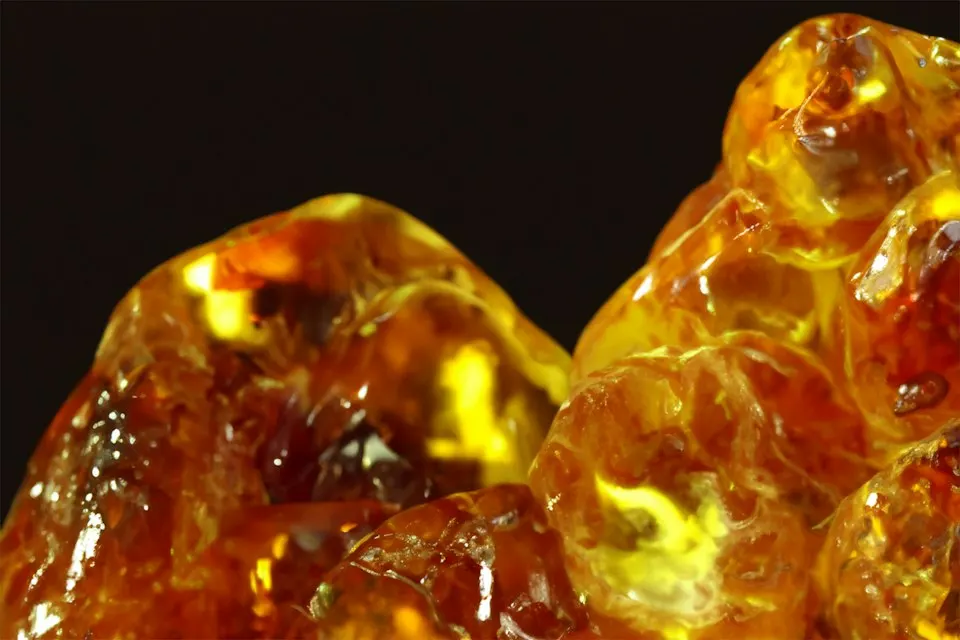
Baltic amber usually glows yellowish-white or bluish. The shade depends on the piece. A weathered, dark crust can dim the glow, so it may be weaker than on a fresh lump.
Shine the torch on the band of debris from about a metre away and sweep the beach slowly. Mark the spot of a glowing point, then check it in your hand under white light.
Searching with a torch, step by step
- Wait for full darkness. Street lamps, moonlight and resort lights drown out a faint glow.
- Walk along the fresh strandline and shine the light low, at an angle to the sand.
- Look closely at wet debris and shallow puddles left by the retreating water.
- Put finds straight into a metal container of water.
UVA light is invisible, so you cannot tell when you are shining it in someone's eyes. Watch where the beam points.
What else glows under UV
Not every glow is amber. These also glow under UV:
- some plastics and bits of polystyrene,
- white fabric, paper and string treated with optical brighteners,
- some shells and pieces of fluorescent glass,
- paints and markings on rubbish washed up from the sea.
So judge every find again in daylight. Our guide on how to identify amber covers the salt water test, warmth in the hand and weight.
White phosphorus: a warning
White phosphorus from munitions turns up on Baltic beaches. It looks like pale amber. Once dry, it can ignite and cause deep burns.
A UV glow does not rule out phosphorus. Phosphorus itself can glow faintly in the dark, so a glow at night proves nothing.
- Do not put finds in your pocket.
- Keep them in a metal container filled with water.
- Leave a suspicious piece in the water where it is and call the emergency number, 112 (Nocowanie.pl, in Polish).
Night safety after a storm
After a storm the sea is still rough, and in the dark you cannot see the next wave. Stay above the strandline and go no deeper than your ankles.
- Go with another person and tell someone where you are.
- Take a head torch with white light. A UV torch alone will not show you a log or a hole in the sand.
- Never shine UV into your own or anyone else's eyes. For longer use, wear glasses with a UV filter.
- Avoid undercut dunes and cliffs. Sand slides after a storm.
Before you go, check the forecast for your beach, for example Krynica Morska, where a UV torch works well in the evening.
Do not miss the next window
The best windows last a few hours: after a storm, after rain, on a clear night with an active Sun. Sign up and we will email you when the index at your spots goes above 60.