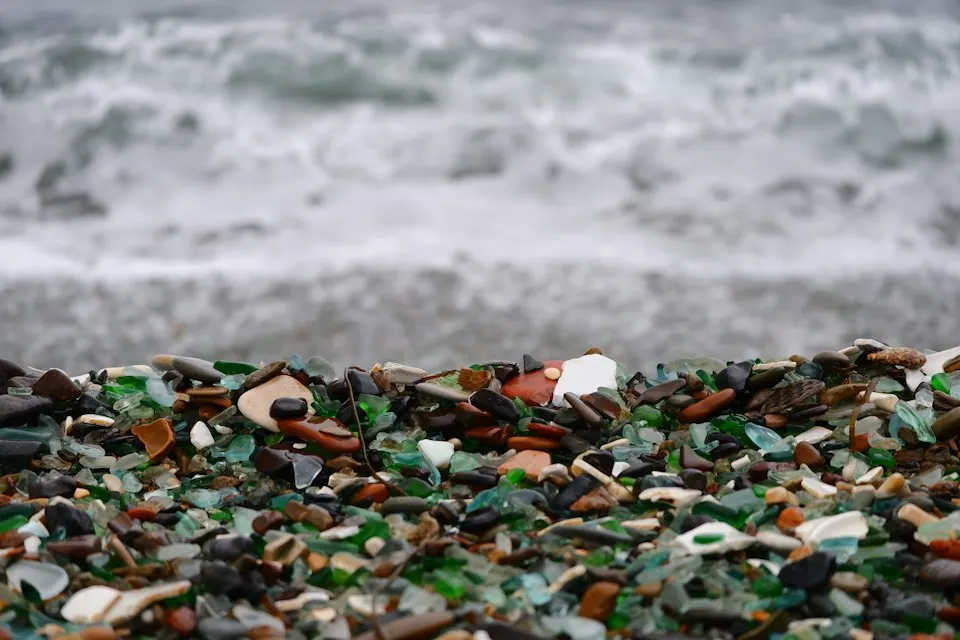
Most sea glass is worth more to the collector than to the market. A handful of common pieces sells online for a few to a few dozen dollars. Single rare pieces, though, fetch hundreds, and exceptional ones even thousands of dollars.
What sea glass costs
There is no price list. Sellers set their own prices, and the International Sea Glass Association (ISGA) points out that a high price does not prove a piece is genuine. To show the order of magnitude, we noted some Etsy listings on 30 October 2026:
- 50 pieces described as genuine Puerto Rico sea glass: about $6.80.
- 50–100 medium and large pieces in mixed colours, described as genuine: about $38.
- Single “jewellery grade” pieces 3–5 cm (1.25–2 in) long: about $18.
- Bulk mixes of “red, blue, yellow, orange”: about $7–21.
The last item is a warning. Red turns up in the sea about once in 5,000 pieces and orange once in 10,000. A bag of those colours for a few dollars is almost certainly artificial. ISGA says it plainly: a rare colour at a very low price is probably not genuine sea glass.
At the other end of the scale are collector pieces. According to the Polish weekly Tygodnik Powszechny, the most valuable sea glass sells for up to several thousand dollars.
What adds value
- Colour. Red, orange, yellow, turquoise and true black are worth the most. See what is sea glass.
- Size and shape. Large, thick pieces and regular shapes are easier to set in jewellery.
- Frosting. An even frost with no shiny patches shows a long time in the sea.
- Pieces with a story. Bottle necks and stoppers, fragments with lettering, bottle marbles and jug handles are prized by collectors.
- Origin. Seaham glass, especially the multicoloured “multis”, and Davenport art glass have their own reputation.
How to tell genuine sea glass from fakes
Artificial “sea glass” is made by tumbling glass with sand, by sandblasting or by acid etching. It can be pretty, but it is a different product. ISGA and collectors’ references list several features that help:
- C-shaped marks. Genuine pieces often have tiny half-moon impact marks from stones. This is one of the most reliable signs.
- Uneven surface. Genuine sea glass is more frosted in some places than others, and may show fine surface cracking.
- Irregular shape. A piece from the sea comes from a real bottle or dish. It has a curve, a seam line, lettering or part of a base.
- Suspicious uniformity. Artificial glass has a uniform, satin-like texture and similar shapes: squares, ovals, triangles. It often has sharp or blocky edges.
- Colours without a history. Lots of rare, intense colours in one batch is a warning sign.
How to sell honestly
- State the real origin. Say which beach and country the glass came from. Buyers ask more and more often.
- Do not mix genuine and artificial glass. If your jewellery uses tumbled glass, say so clearly.
- Do not sell glass from places where collecting is banned. That includes Glass Beach in Fort Bragg and Praia dos Cristais in Laxe. Details are in rules and bans.
- Photograph wet and dry. Wet shows the colour, dry shows the texture.
- Check the tax rules. Selling a collection once is different from trading jewellery regularly. If you sell often, check the rules for small or informal businesses where you live.
Baltic sea glass
Sea glass from Polish beaches is mostly green, brown, white and blue. Its market value is low, but local workshops make jewellery from it and sell it as a Baltic keepsake. If you find cobalt or a rarer colour at Sopot or near the old ports, keep it with a note of the place and date. That record makes the piece more valuable to collectors.
Sources
- International Sea Glass Association: Genuine vs. Artificial
- Etsy: sea glass listings (snapshot 30 Oct 2026)
- Tygodnik Powszechny: the most valuable “mermaid’s tears” (Polish)
- Wikipedia: Sea glass
- Beachcombing Magazine: Davenport, California
- Sopot Sea Glass: FAQ (Polish)
Do not miss the next window
The best windows last a few hours: after a storm, after rain, on a clear night with an active Sun. Sign up and we will email you when the index at your spots goes above 60.