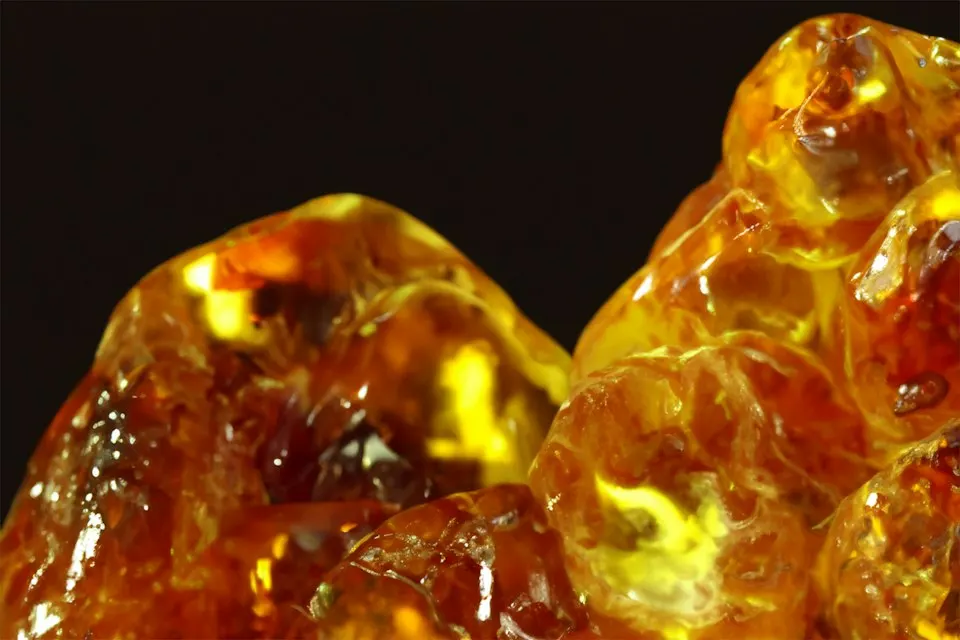
Go for amber when the storm blew onto your beach and the waves are just dropping. The best time is the first hours after the peak, for about a day and a half.
Which wind washes up amber
What matters is wind blowing from the sea onto the shore. The Vistula Spit and Sobieszewo Island react to north and north-west winds. Sopot reacts to the east. Gdańsk Stogi and Brzeźno react to north and north-east.
Wind is named after the direction it blows from. A north-westerly wind blows from the NW. Our guide on where to find amber has the details for each place.
How high the waves must be
Most amber moves after long, strong swell. What counts is not one peak but the hours when waves hit the seabed again and again. So several hours of wind give more than one hour of strong gusts.
We calculate wave height at a point about 3 km offshore, in the direction the beach faces. Close to shore the waves are often lower, because the seabed slows them. On sandbars you can see this in the line of breaking waves.
Above 2 m of wave height, the site shows a warning. On the beach, stay well away from the water then.
Time after the storm peak
The peak is the moment of the highest waves. When the waves start to drop, the sea gives back what it stirred up. The wrack is then at its freshest, and nobody has walked it yet.
- At the peak: material is on the move, and going onto the beach is dangerous.
- Waves dropping: the best moment.
- A day or two later: the wrack is still there, but people and the sea have already scattered it.
Hunters' experience agrees: the morning after a storm, as the wind eases, is best (Nocowanie.pl, in Polish).
How we calculate the amber index
For each beach and each hour we combine four things. Wave and wind data come from Open-Meteo.
- Onshore wave energy over the last 48 hours. We count how much wave and wind pushed towards the beach. Older hours count for less than recent ones.
- Storm phase. Waves dropping but still clearly present: the highest score. At the peak the score is lower, and in complete calm it is slightly lower than while waves are dropping.
- Freshness of the wrack. Up to 36 hours after the peak the score is full. Then it falls over roughly a day.
- Beach richness. A fixed value for each beach. Mikoszewo and Jantar score highest, Kołobrzeg low.
The result is a number from 0 to 100 for the chosen hour. The weights are provisional, and we calibrate them with reports of finds. Treat the index as a guide, not a guarantee.
What the index does not know
The model cannot see who was on the beach before you, or whether a stretch is closed. It also does not know local obstacles such as breakwaters, river mouths and seabed changes after earlier storms.
So check the beach itself for a fresh line of debris. If there is none, the sea has washed up nothing, whatever the forecast says.
A plan for the day after a storm
- In the evening, open the forecast and find the beach with the highest score.
- Go out at dawn, when the waves are dropping and the beach is empty.
- Walk along the fresh strandline, not at the water's edge.
If you dive, that is a different window: see the post-storm dive window. Underwater you must wait for the waves to settle. Sand usually covers the seabed again within one to three days.
Do not miss the next window
The best windows last a few hours: after a storm, after rain, on a clear night with an active Sun. Sign up and we will email you when the index at your spots goes above 60.